A Classic That Never Stops Changing
Today I want to talk about the Negroni.
We are getting closer to Negroni Week, and I think this is the perfect moment to talk about a cocktail that is, in one way or another, part of all of our lives.
The Negroni is one of those drinks that never really stays the same. Every bartender has tried to make their own version. Maybe a lighter summer Negroni, a richer winter version, a sweeter one, a more bitter one, or something completely different.
Everyone wants to add their own twist.
But before changing a classic, I think it is important to understand where it comes from.
A Little History
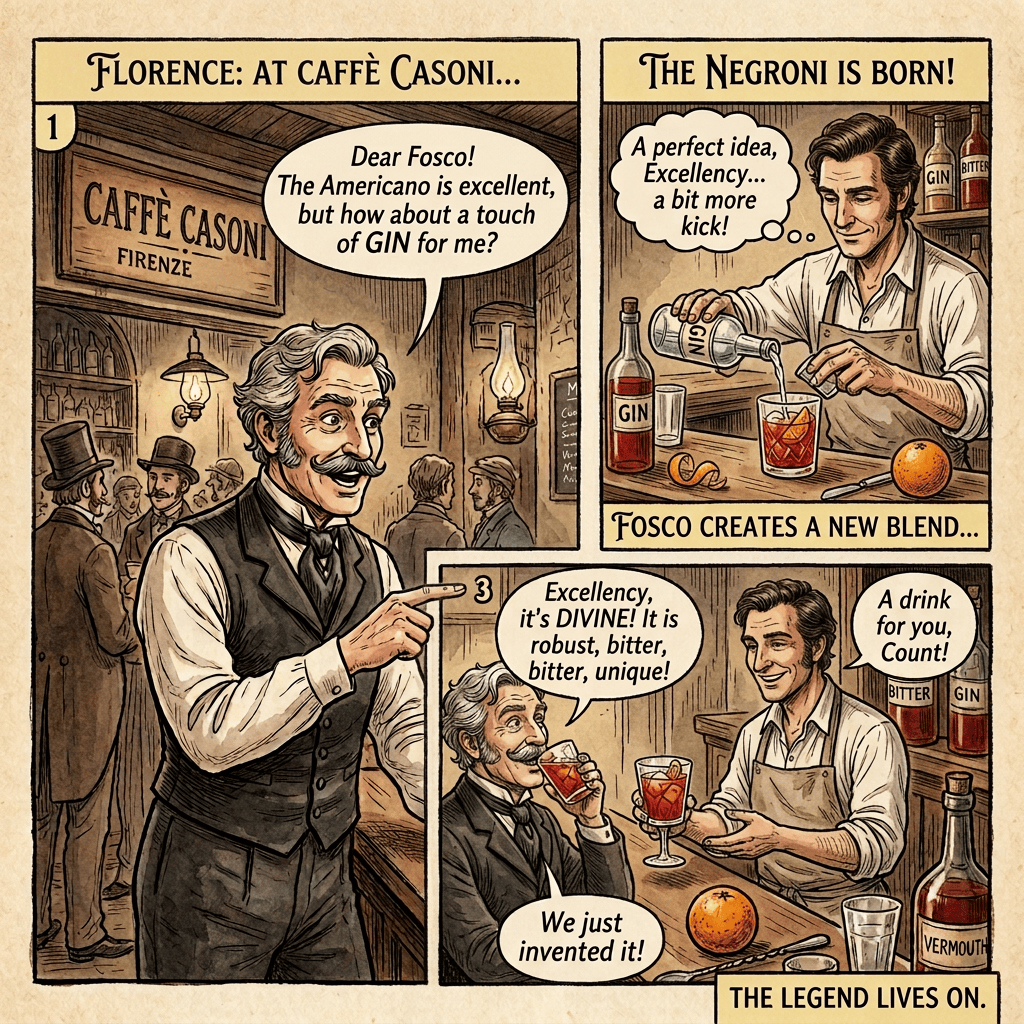
The story of the Negroni takes us back between 1917 and 1920, at Cafe Casoni in Firenze.
The legend says that Count Camillo Negroni, a Tuscan nobleman, discovered gin during his travels, including time spent in America and England.
When he returned to Italy, he apparently asked his trusted bartender to make his usual Americano a little stronger. Instead of soda water, he asked for gin.
The result was a stronger, more alcoholic version of the Americano.
The Count liked it. His friends liked it too, and soon other guests started asking for a drink “like Count Negroni’s.”
And, according to the legend, the Negroni was born.
Of course, like many cocktail stories, it is difficult to know exactly how much of this is true and how much has become legend over the years. But honestly, I think that is part of the fun.
Three Ingredients. That’s It.
The classic Negroni is a very simple cocktail.
The traditional recipe is equal parts:
- Gin
- Campari
- Sweet vermouth
Add plenty of good ice and an orange garnish.
That’s it.
Three ingredients, in equal proportions, with nothing to hide behind.
Of course, bartenders have been changing the proportions for years. Some make it sweeter, some drier, some more bitter. It often depends on personal taste, the style of the bar and, of course, what customers like.
But when we talk about a classic Negroni, the idea is still very simple: equal parts gin, Campari and sweet vermouth.
And maybe that is one of the reasons why this cocktail has survived for so long.

The Negroni Today
In recent years, the Negroni has become incredibly popular, especially outside Italy.
It has reached the same kind of international fame as cocktails such as the Old Fashioned and the Aperol Spritz.
You can find people drinking Negronis almost everywhere and at almost any time: aperitivo, dinner, after dinner… it doesn’t really matter.
People love the classic, but they are also curious about new versions.
This is what makes the Negroni so interesting to me. It is a cocktail with very strong foundations, but at the same time it gives bartenders a lot of freedom.
The Rise of Big Ice and Pre-Batching
One of the biggest changes in the way we serve Negronis has been the use of large ice cubes.
A few years ago, you would normally see a Negroni served over regular ice. Today, you often see it in a low tumbler with one large, clear cube.
Something like a 5 × 5 × 7 cm cube.
It looks clean, elegant and minimal.
Another important trend in modern bartending is pre-batching.
Instead of making every Negroni from scratch during service, the bartender prepares a larger batch in advance and keeps it cold. When an order comes in, the drink is measured, stirred with ice to cool and dilute it, and then served.
There are several reasons why this works very well.
First of all, the cocktail becomes more consistent. Every guest gets basically the same drink.
It also makes service faster and reduces waste. Instead of measuring three different bottles for every cocktail, the bartender can work from one prepared batch.
For a busy bar, this can make a big difference.
Personally, I think pre-batching is an excellent technique. But I also really enjoy a Negroni made traditionally, as long as the ice is good quality.
Maybe the subject of pre-batching deserves its own article. If you are interested, let me know in the comments.

The Ingredients Really Matter
Even if the recipe is simple, the ingredients make a huge difference.
For the bitter component, Campari is still, in my opinion, one of the best choices.
But there are some very good alternatives.
One that I have been enjoying recently is Fusetti Bitter. It is becoming more and more popular, and I understand why.
Compared with Campari, I find it slightly less bitter and a little sweeter, while still having a strong citrus character. It is also very versatile.
For the vermouth, things become much more personal.
A lot depends on the style you are looking for.
At the moment, I really enjoy using Mancino Rosso. I also think Bordiga Rosso is a very interesting choice, especially their organic version. The guys at Bordiga are doing some really interesting work.
And then there is Carpano.
Carpano is a more classic choice, but it is also one of those products that is difficult to get wrong. When in doubt, Carpano is a very solid option.
For the gin, I think the choice is especially important.
You need a gin with some character. Something that doesn’t completely disappear behind the Campari and vermouth.
I personally prefer a fresh, citrus-driven London Dry style gin, with enough personality to stay present in the cocktail.
Some Negroni Twists I Love
The classic Negroni is great, but there are some variations that I have found really fun over the years.
One of them is the White Negroni.
Instead of Campari and red vermouth, you can work with gin, white vermouth and a bitter such as Suze. The result has a completely different colour and character, with herbal and bitter notes.
Then there is the Coffee Negroni.
Coffee and Campari work surprisingly well together.
One way to make it is to infuse the bitter with coffee for a couple of days and then use it to build the Negroni.
You can finish it with a coffee bean or even a little coffee powder.
Another fun variation is the Kingston Negroni, which uses a coconut-forward rum. It can give the drink a flavour that reminds me a little of a Bounty chocolate bar.
These are just a few examples.
There are so many possible Negroni twists that each one could probably have its own article.
If you are interested, let me know in the comments and I can talk about some of the classic Negroni variations in more detail.
My Negroni
After all these variations, I still come back to the classic.
My personal preference is for a slightly sweeter Negroni, with the vermouth playing a little more of a leading role.
I like to stir it with ice until it is properly chilled and diluted, then serve it in a nice low glass with a fresh orange peel.
Nothing complicated.
For me, the Negroni is the perfect pause.
It is recognizable, unique and impossible to confuse with anything else.
It is also a drink that brings back memories.
Aperitivo with friends. Long dinners. Special occasions. Moments of conversation.
Maybe that is why the Negroni means something different to everyone.
Negroni and Pizza Marinara
And finally, if I had to choose one food pairing for this Negroni, I would go for something very simple: pizza marinara.
It might sound like an unusual combination, but I think it works incredibly well.
The simplicity of the pizza allows the flavours to work together. The aroma of the dough, garlic, Taggiasca olives and oregano works beautifully with the citrus and bitter notes of the Negroni.
Garlic and citrus are a particularly good combination, and olives and orange work surprisingly well together too.
It is a pairing I really recommend trying.
A simple pizza marinara, a well-made Negroni, good friends around the table.
Sometimes you really don’t need anything more…
Have nice negroni week everyone and don’t forget to…Cheers!!
